 +91 9001007171

Introduction
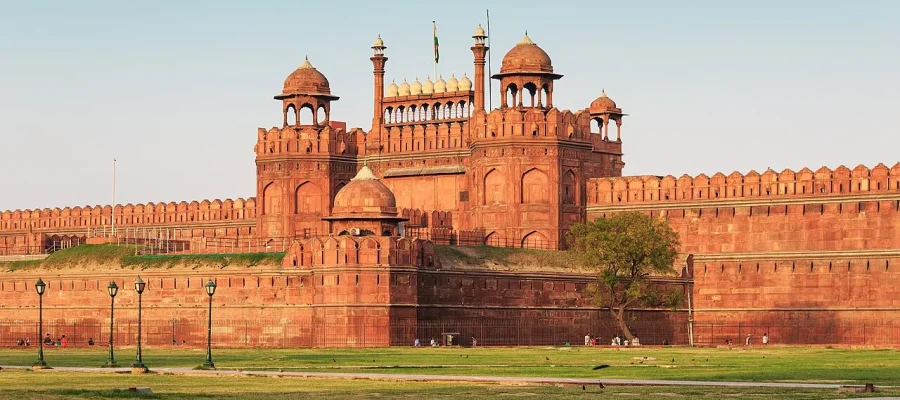
The Red Fort Delhi, locally known as Lal Kila, stands as one of India’s most iconic landmarks and a powerful reminder of its imperial Mughal past.
For almost 200 years it was the palace of the Mughal emperors, and today it is the place where India celebrates its freedom every year. For travellers arriving from abroad, it is usually the first great monument of an India journey and the natural starting point of a Golden Triangle tour.
This guide covers who built it and why, its history, what to see inside, timings and practical tips for international visitors.
Where is Red Fort Situated?
The Red Fort is located in Old Delhi, a historic district that once formed the walled city of Shahjahanabad.
It stands on Netaji Subhash Marg, at the eastern end of Chandni Chowk, close to the Yamuna river. Jama Masjid is about one kilometre away, so the two are almost always visited together.
| From | Approx. distance | Approx. travel time |
|---|---|---|
| Connaught Place (central New Delhi) | 6 km | 20 to 30 minutes |
| New Delhi Railway Station | 4 km | 15 to 20 minutes |
| Indira Gandhi International Airport | 22 km | 45 to 75 minutes |
| Aerocity hotels | 20 km | 45 to 60 minutes |
Who Built Red Fort in Delhi and Why?
The Red Fort was built by Shah Jahan, the fifth Mughal emperor, who also built the Taj Mahal in Agra.
- The decision to build the Red Fort came after Shah Jahan moved the capital from Agra to Delhi to establish a new center of administration.
- He founded a new walled city, Shahjahanabad, with the fort as its palace and seat of government.
- The chief architect was Ustad Ahmad Lahauri, who is also credited with the design of the Taj Mahal.
- The fort was originally called Qila-i-Mubarak, the Blessed Fort. The name Red Fort comes from its massive red sandstone walls.
When Was Red Fort Built?
Construction began in 1638 and was completed in 1648, taking about ten years. Shah Jahan’s son Aurangzeb later added the Moti Masjid (Pearl Mosque) in 1659.
Red Fort History Through the Ages
| Period | What happened |
|---|---|
| 1638 to 1648 | Shah Jahan builds the fort as the palace of his new capital, Shahjahanabad |
| 1659 | Aurangzeb adds the white marble Moti Masjid |
| 1739 | The Persian ruler Nadir Shah invades Delhi and carries away the Peacock Throne and the Koh-i-Noor diamond |
| 1857 | After the uprising against British rule, the last Mughal emperor, Bahadur Shah Zafar, is tried here and exiled. The British take over the fort, demolish many palaces and build army barracks |
| 1945 to 1946 | The trials of Indian National Army officers are held in the fort and stir the independence movement |
| 1947 | Jawaharlal Nehru, the first Prime Minister, raises the Indian flag at the Red Fort as India becomes independent |
| 2007 | The Red Fort Complex is declared a UNESCO World Heritage Site |
- Since then, the Prime Minister hoists the tricolor and addresses the nation from the Red Fort every Independence Day, reinforcing its status as a symbol of sovereignty.
- The fort is also a key site for Republic Day celebrations, heritage walks, and cultural events organized by the Archaeological Survey of India.
What to See Inside the Red Fort
The fort covers about 250 acres, and the main buildings lie along one line from the entrance gate to the river side. Follow this order and you will not miss anything.
- Lahori Gate: the grand main entrance, facing Chandni Chowk. The national flag is raised above this gate on Independence Day.
- Chhatta Chowk (Meena Bazaar): a covered arcade where merchants once sold silk, jewellery and carpets to the royal household. It is still lined with souvenir shops.
- Naubat Khana (Drum House): musicians played here five times a day and announced the arrival of the emperor.
- Diwan-i-Aam (Hall of Public Audience): a hall of red sandstone arches where the emperor heard the petitions of his people from a marble throne balcony.
- Diwan-i-Khas (Hall of Private Audience): a white marble pavilion that once held the jewelled Peacock Throne. A Persian verse on its walls reads: if there is a paradise on earth, it is this, it is this, it is this.
- Rang Mahal (Palace of Colours): the residence of the royal women, once cooled by a marble water channel called the Stream of Paradise.
- Khas Mahal: the emperor’s private apartments, with a finely carved marble screen bearing the scales of justice.
- Hammam: the royal baths, built in marble with inlaid floors.
- Moti Masjid (Pearl Mosque): a small, graceful mosque built by Aurangzeb for his private prayers.
- Hayat Bakhsh Bagh: the Life-Giving Garden, with pavilions and water channels in the Mughal style.
- Museums: the British-era barracks now house museums on the 1857 uprising, Subhas Chandra Bose and the Indian National Army, and India’s freedom struggle.
Some interiors are viewed from outside only, to protect the marble and inlay work.
Is Red Fort Open Today?
The Red Fort is open from Tuesday to Sunday and is closed every Monday.
| Detail | Information |
|---|---|
| Opening hours | 9:30 AM to 4:30 PM |
| Closed | Every Monday |
| Last entry | About 4:00 PM |
| Time needed | 2 to 3 hours |
| Tickets | Online through the Archaeological Survey of India portal, or at the ticket counter near the entrance |
The fort also closes to the public for several days before Independence Day on 15 August, and access can be restricted around national events in late January. Timings are set by the Archaeological Survey of India and can change, so check before you go.
Light and sound show
An evening light and sound show tells the story of the fort and of India’s journey to independence, with shows in Hindi and in English from Tuesday to Sunday. Show times change with the season, so confirm on the day of your visit.
Fascinating Facts About Red Fort
- Built from Red Sandstone: the walls are made of red sandstone and run for about 2.4 km, rising to 33 metres on the city side.
- A palace of marble inside: behind the red walls, the royal apartments were built in white marble with gold, silver and precious stone inlay.
- Home of the Peacock Throne: the famous jewelled throne stood in the Diwan-i-Khas until it was taken to Persia in 1739.
- The Koh-i-Noor was here: the diamond was part of the Mughal treasury kept in the fort.
- On the banknote: the Red Fort appears on the back of the ₹500 note.
- Two main gates: the Lahori Gate faces Lahore, and the Delhi Gate faces the older city of Delhi.
- Once beside the river: the Yamuna used to flow along the eastern wall and fed the moat. The river has since shifted away.
- A UNESCO World Heritage Site: it was listed in 2007 together with the older Salimgarh Fort next to it.
Common Misconceptions: Redford India vs Red Fort
Many travellers search for “Redford India” or “Redford Delhi”. This is simply a misspelling.
- The correct name is Red Fort, a famous historical monument in Old Delhi.
- Red Fort is a UNESCO World Heritage Site.
- In Hindi and Urdu it is called Lal Kila or Lal Qila, which means Red Fort.
- It is not the same as the Agra Fort, which is also built of red sandstone and is sometimes called the Red Fort of Agra. The two are about 230 km apart.
Travel Tips for Visiting Red Fort in Delhi
- Go early: arrive at 9:30 AM for cooler weather, softer light and shorter queues.
- Avoid Mondays: the fort is closed. Weekends and public holidays are the most crowded.
- Book tickets online: it saves time at the counter. Foreign visitors have a separate ticket window.
- Wear comfortable shoes: the complex is large and you will walk two to three kilometres.
- Carry water, a hat and sunscreen: there is little shade between the buildings.
- Hire a licensed guide: the buildings have few signs, and the stories bring them to life.
- Photography: allowed for personal use. Tripods and drones are not permitted.
Visiting Red Fort as an International Traveller
The Red Fort is easy and safe to visit, and a few extra points help first-time visitors to India.
Security and what to bring
- Everyone passes through airport-style security at the entrance. Carry a small bag only, as large bags and luggage are not allowed.
- Food, tobacco, lighters and sharp objects are not permitted inside.
- Carry your passport or a copy, and pay by card or in Indian rupees.
- There is no strict dress code, but modest clothing is respectful and also needed if you continue to Jama Masjid, where shoulders and legs must be covered.
Getting there
| By | Details |
|---|---|
| Private car | The most comfortable option. Your driver drops you at the parking area, a short walk from Lahori Gate |
| Metro | Lal Qila station on the Violet Line is right beside the fort. Chandni Chowk station on the Yellow Line is about a 15-minute walk |
| Cycle rickshaw | The classic way to move between the Red Fort, Jama Masjid and Chandni Chowk. Agree the price before you start |
Avoiding common problems
- Buy tickets only online or at the official counter, and use only licensed guides with a government ID card.
- Ignore anyone outside who says the fort is closed today and offers to take you elsewhere.
- Keep your phone and wallet secure in the crowds of Chandni Chowk.
- Traffic in Old Delhi is slow, so allow extra time before a flight or train.
Best time to visit
| Season | Months | What to expect |
|---|---|---|
| Winter (best) | October to March | Pleasant days. Morning fog and haze are common from November to January |
| Summer | April to June | Very hot, often above 40°C. Visit at opening time only |
| Monsoon | July to September | Humid with heavy showers, but the gardens are green and crowds are smaller |
Places to Visit Near Red Fort
| Place | Distance | Why go |
|---|---|---|
| Jama Masjid | 1 km | One of India’s largest mosques, also built by Shah Jahan, with views over Old Delhi from its minaret |
| Chandni Chowk | Opposite the fort | A 17th-century market street full of food, jewellery, fabric and wedding shops |
| Khari Baoli | 2 km | Asia’s largest wholesale spice market |
| Paranthe Wali Gali | 1 km | A narrow lane famous for stuffed fried flatbreads |
| Gurudwara Sis Ganj Sahib | 700 m | An important Sikh shrine with a free community kitchen |
| Raj Ghat | 2.5 km | The peaceful memorial to Mahatma Gandhi |
A perfect Old Delhi morning
- 9:30 AM: Red Fort with a guide.
- 12:00 PM: cycle rickshaw ride through Chandni Chowk and the spice market.
- 1:00 PM: Jama Masjid.
- 1:45 PM: lunch at a well-known Old Delhi restaurant.
- 3:00 PM: Raj Ghat, then drive to New Delhi for India Gate and Humayun’s Tomb.
For a fuller plan, see our Perfect Delhi Itinerary for 2 Days.
Explore Delhi and the Golden Triangle with Dream Day Tours
Dream Day Tours is a government-approved travel company based in Jaipur, founded in 2019. Every tour is customised to your dates, pace and interests, with private cars, local expert guides and handpicked hotels.
The Red Fort is where most of our Golden Triangle journeys begin. From Delhi you continue to the Taj Mahal in Agra and the palaces of Jaipur, and you can add tigers in Ranthambore, the lakes of Udaipur or the ghats of Varanasi.
- Old Delhi and New Delhi day tour
- 5 Days Golden Triangle Tour India
- Golden Triangle with Ranthambore and Udaipur
- Golden Triangle with Varanasi
- Plan Your Perfect Varanasi 2-Day Itinerary
Write to us at welcometoddtours@gmail.com with your travel dates, and we will send a tailor-made itinerary.
Frequently Asked Questions
Where is the Red Fort situated?
The Red Fort is in Old Delhi, on Netaji Subhash Marg at the eastern end of Chandni Chowk, in the former walled city of Shahjahanabad.
Who built the Red Fort?
The Mughal emperor Shah Jahan built the Red Fort when he moved his capital from Agra to Delhi.
When was the Red Fort built?
Construction began in 1638 and was completed in 1648.
Is the Red Fort open today?
The Red Fort is open from 9:30 AM to 4:30 PM, Tuesday to Sunday. It is closed every Monday and for several days before Independence Day on 15 August.
How much time do I need at the Red Fort?
Allow 2 to 3 hours for the fort, and half a day if you add Jama Masjid and Chandni Chowk.
Why is it called the Red Fort?
It is named after its high walls of red sandstone. Its original name was Qila-i-Mubarak, the Blessed Fort.
Is “Redford India” the same as the Red Fort?
Yes. “Redford” is a common misspelling. The correct name is Red Fort, or Lal Kila in Hindi.
Is the Red Fort the same as the Agra Fort?
No. The Red Fort is in Delhi and the Agra Fort is in Agra, about 230 km away. Both were Mughal palaces built of red sandstone.
Which metro station is nearest to the Red Fort?
Lal Qila station on the Violet Line is beside the fort. Chandni Chowk station on the Yellow Line is about a 15-minute walk.
Is photography allowed inside the Red Fort?
Yes, photography for personal use is allowed. Tripods and drones are not permitted.
Is there a light and sound show at the Red Fort?
Yes. An evening show in Hindi and English runs from Tuesday to Sunday. Timings change by season.
Is the Red Fort worth visiting?
Yes. It is a UNESCO World Heritage Site, the finest Mughal palace complex in Delhi and the symbol of Indian independence.
Is the Red Fort safe for international and solo travellers?
Yes. The fort has strong security and is very safe. Take normal care with valuables in the busy streets of Old Delhi outside.
What is the best time to visit the Red Fort?
October to March has the best weather. Arrive at opening time on a weekday for the quietest visit.
Can I combine the Red Fort with a Golden Triangle tour?
Yes. The Red Fort is part of the Delhi sightseeing on every Golden Triangle tour, which continues to Agra and Jaipur.